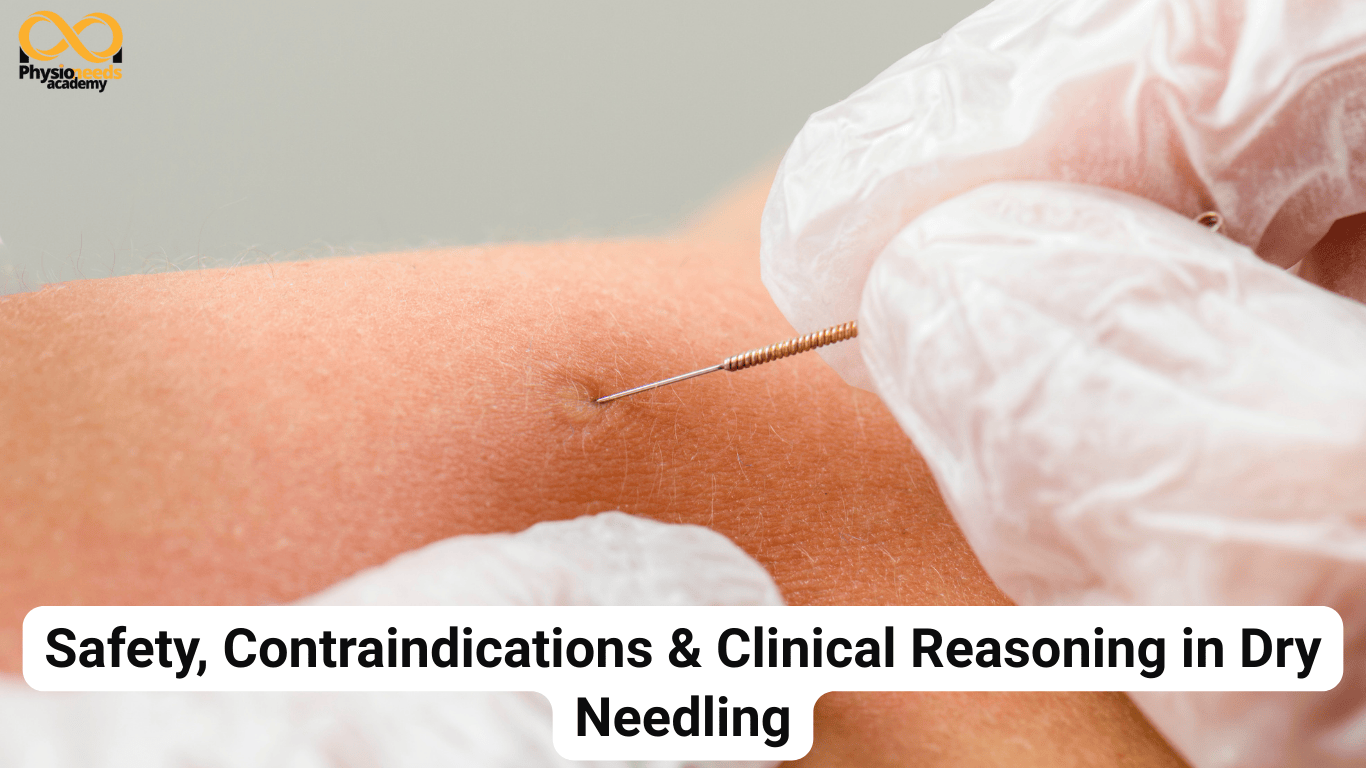
Safety, Contraindications & Clinical Reasoning in Dry Needling

Dry needling is a powerful clinical tool.
But in unskilled or uninformed hands, it can quickly become a liability instead of a solution.

For physiotherapists, mastering dry needling is not just about learning where to insert a needle—it is about knowing when, why, and when not to.

True professionalism begins with safety and clinical reasoning.

Why Safety Is Non-Negotiable in Dry Needling

Dry needling is an invasive technique.
That single fact demands:

  • Sound anatomical knowledge
  • Clear clinical indication
  • Strict safety protocols
Patients don’t judge you by how confident you look—they judge you by how safe they feel.

Safety builds:

  • Trust
  • Professional credibility
  • Long-term practice sustainability

Absolute vs Relative Contraindications

An expert physiotherapist distinguishes clearly between absolute and relative contraindications.
Absolute Contraindications
Dry needling should be avoided in:

  • Patient refusal or fear
  • Active infection at the site
  • Local malignancy
  • Severe bleeding disorders
  • Uncontrolled anticoagulant use
  • Lack of practitioner training
No clinical outcome justifies violating these.

Relative Contraindications

Dry needling requires caution in cases such as:

  • Pregnancy
  • Diabetes with poor wound healing
  • Compromised immune system
  • Recent surgery
  • Extreme pain sensitivity
  • Psychological apprehension
In these cases, clinical judgment—not protocol—guides decisions.

Anatomy: Your First Line of Defense

Most dry needling complications arise from poor anatomical awareness, not bad intentions.

Every physiotherapist must have:

  • Clear understanding of depth
  • Knowledge of underlying structures
  • Awareness of neurovascular pathways
  • Respect for organ proximity
Needling without anatomical precision is not advanced care—it is guesswork.

Clinical Reasoning: The Core Skill

Dry needling is never the first question.
The first question is:
Is this tissue the primary pain generator?
Clinical reasoning involves:

  • Comprehensive assessment
  • Trigger point confirmation
  • Pain reproduction and referral patterns
  • Movement correlation
Only then does dry needling become indicated, not assumed.

Informed Consent Is Clinical Responsibility

Patients must understand:

  • What dry needling is
  • Why it’s being used
  • Possible sensations and soreness
  • Expected outcomes
  • Alternative options
Informed consent is not paperwork—it is ethical practice.

Post-Needling Care Matters

Safety doesn’t end when the needle is removed.

Physiotherapists must:

  • Monitor post-treatment response
  • Educate about soreness
  • Advise hydration and movement
  • Integrate gentle mobility or exercise
Ignoring aftercare reduces outcomes and increases dissatisfaction.

Skill-Up Is the Best Safety Tool

Most adverse events occur when practitioners:

  • Learn from shortcuts
  • Skip supervised training
  • Copy techniques without reasoning
Proper certification ensures:
  • Structured learning
  • Supervised practice
  • Complication management
  • Confidence without arrogance

Final Clinical Takeaway

Dry needling is not dangerous.
Untrained practice is.

When applied with:

  • Knowledge
  • Precision
  • Ethical judgment
Dry needling becomes one of the safest and most effective tools in musculoskeletal physiotherapy.
Safety is not a limitation—it is the foundation of mastery.

🔗 Learn Dry Needling the Right Way

At Physioneeds Academy, dry needling training emphasizes:

  • Safety-first protocols
  • Anatomy-driven precision
  • Clinical reasoning
  • Ethical and legal practice
Because great results mean nothing without safe practice.