
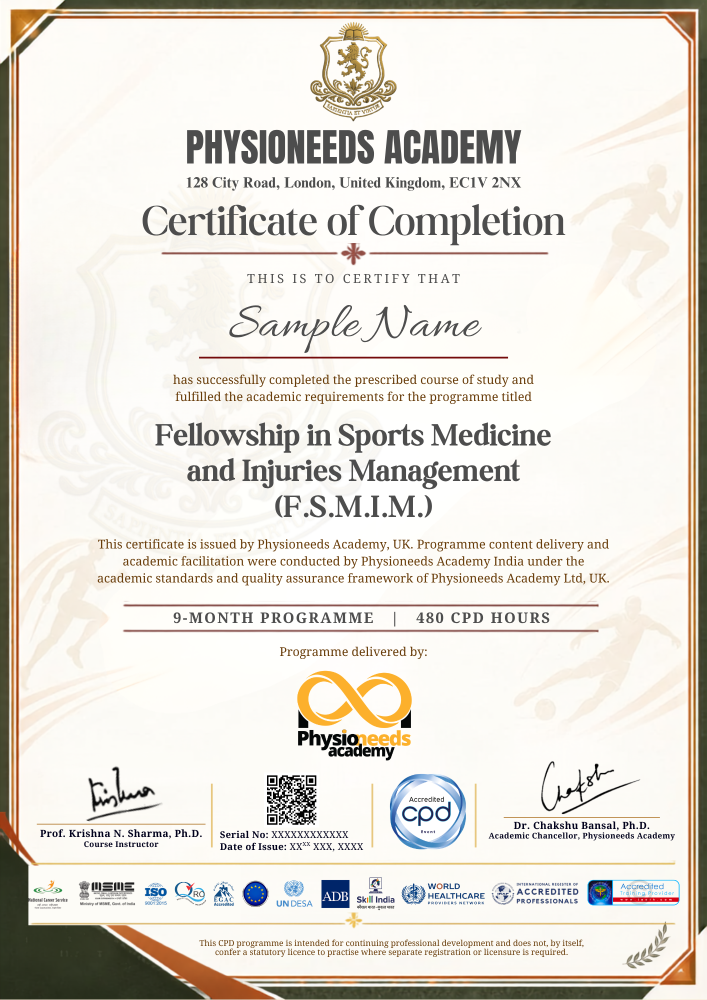
F.S.M.I.M. Certificate 1

An advanced 9-month, 450 CPD Hour, mentor-led Fellowship in Sports Medicine and Injuries Management for physiotherapy students and professionals who want structured competence in injury prevention, assessment, management, rehabilitation, performance integration and safe return-to-play decision-making.
Explore the certificate formats associated with this fellowship. Final learner certificates are issued after successful course completion and required verification.
Explore the organisations, registrations and professional recognition associated with Physioneeds Academy.
Pain may settle temporarily, but lasting recovery requires understanding tissue pathology, biomechanics, kinetic-chain factors, training load and sport-specific demands together.
Basic examination is not enough when sports cases require palpation, orthopaedic special tests, movement screening, imaging correlation, red-flag checks and clinical decision algorithms.
Manual therapy, dry needling, Advanced IASTM, neurodynamics, cupping, BFR and exercise become useful only when you understand indications, precautions, dosage and progression.
Clearing an athlete requires more than reduced pain. You need functional tests, performance benchmarks, sport-specific movement quality, load tolerance and ethical decision-making.
Recovery must progress through strength, motor control, balance, plyometrics, agility, power and sport-specific retraining before confident return to performance.
F.S.M.I.M. certification, mentor-led education and structured sports-injury training can strengthen your positioning across clinics, rehabilitation centres, fitness environments and sports teams.
Use palpation, orthopaedic special tests, functional movement screening, biomechanics, imaging correlation and red-flag checks to identify injury mechanisms and clinical priorities.
Develop practical skills in manual therapy, soft-tissue techniques, dry needling, Advanced IASTM, neurodynamics, cupping, physical modalities and pain-modulation strategies.
Plan tissue-healing and progressive-loading pathways using strength, motor control, balance, proprioception, core stability, plyometrics, agility and power development.
Use running retraining, hop tests, performance benchmarks, sport-specific movement retraining and ethical return-to-play models to progress athletes safely.
Learn when to apply each technique, when to avoid it, how to integrate it with progressive loading and how to connect treatment decisions with sport-specific functional goals.
The curriculum addresses acute, overuse, tissue-specific and persistent sports problems across clinical, field and return-to-performance settings.
A structured 9-month progression from sports medicine foundations, anatomy and biomechanics to assessment, injury science, advanced manual and interventional techniques, rehabilitation, return-to-play, recovery science and professional clinical integration.
Explore sports-injury assessment, clinical reasoning, manual and interventional techniques, progressive rehabilitation, return-to-play planning and learner outcomes.
See how injury assessment connects with movement analysis, manual and interventional techniques, load management and sport-specific rehabilitation progression.
Review real clinical outcome examples showing how structured assessment, treatment progression and rehabilitation can influence function across complex musculoskeletal and movement-related cases.
Review learner experiences focused on injury assessment, rehabilitation planning, practical technique clarity and stronger sports-medicine positioning.
See how the F.S.M.I.M. certification process, structured curriculum and academy guidance support a professional learning experience.
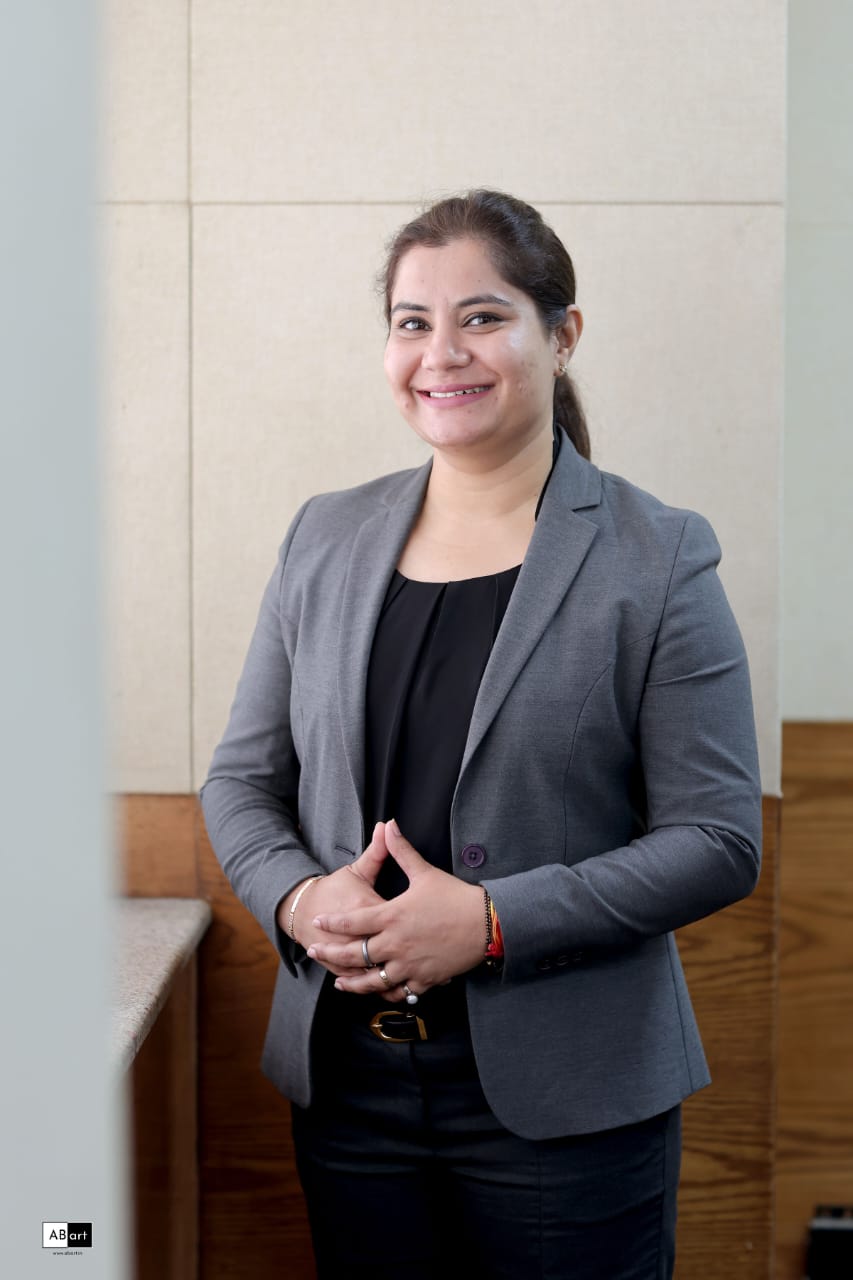
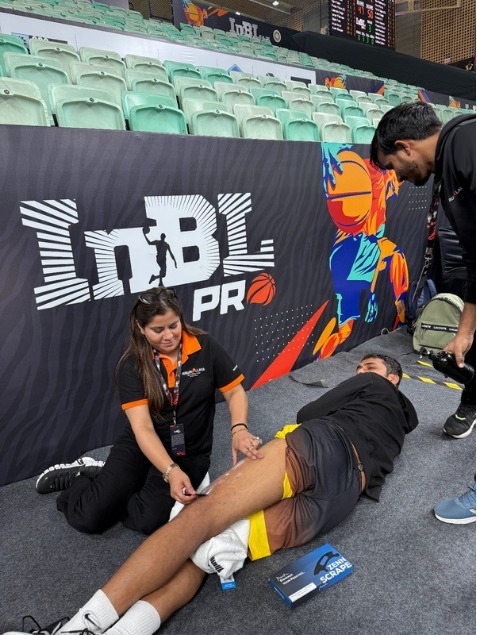
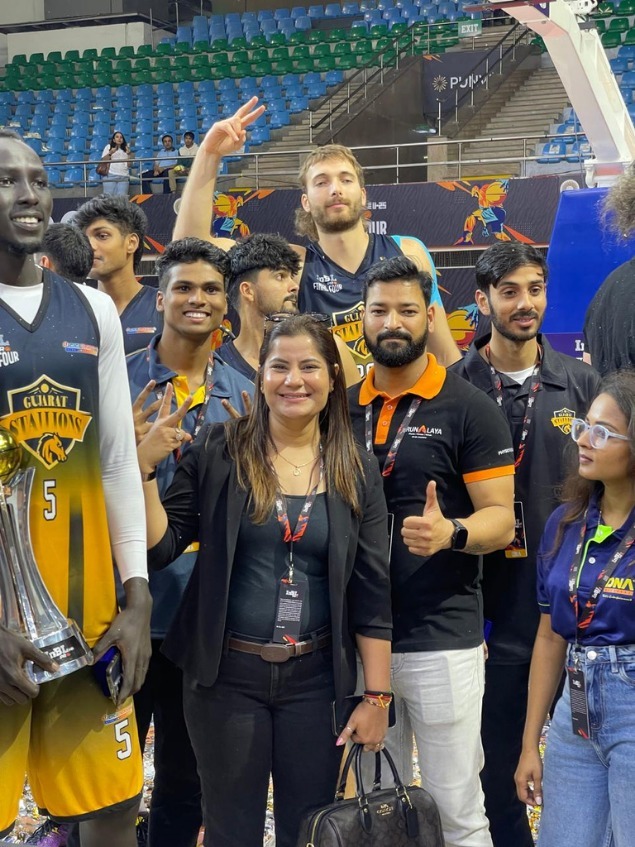
Dr. Chakshu brings 17+ years of clinical, teaching and research experience across musculoskeletal disorders, pain management, sports injuries and rehabilitation, with real-world leadership as Lead Physio for the INBL Pro 2025 Basketball League.
Step-by-step instructor-led access to sports-injury assessment, treatment and rehabilitation techniques.
Structured learning in palpation, special tests, movement screening, imaging correlation and clinical decisions.
Instructor-led demonstrations connecting theory with manual, interventional and rehabilitation application.
Progressive loading, motor-control, strength, agility, power and sport-specific rehabilitation pathways.
Functional testing, performance benchmarks and ethical return-to-play decision models.
Integrate assessment, treatment, rehabilitation and professional reasoning through a sports-injury case project.
Multiple payment options available. Choose full payment or EMI payment in the secure plan popup.
Real-world sports physiotherapy exposure in a professional basketball environment.
F.S.M.I.M. integrates applied sports science, advanced clinical intervention, sport-specific rehabilitation and professional decision-making.
Strengthen your understanding of sports anatomy, biomechanics, tissue healing, load adaptation, fatigue, recovery and injury mechanisms for more informed clinical decisions.
F.S.M.I.M. Learning OutcomeBuild advanced capability in injury assessment, special tests, manual and interventional techniques, rehabilitation planning and safe progression across complex cases.
F.S.M.I.M. Learning OutcomeIntegrate sport-specific rehabilitation, performance benchmarks, ethical return-to-play decisions, athlete communication and interdisciplinary team-based care.
F.S.M.I.M. Learning OutcomeClear answers about F.S.M.I.M. eligibility, curriculum, sports-injury skills, practical learning, certification, return-to-play and career application.
The Fellowship in Sports Medicine and Injuries Management (F.S.M.I.M.) is an advanced, mentor-led nine-month, 450 CPD Hour sports medicine and injuries management fellowship from Physioneeds Academy for physiotherapy students and professionals who want structured competence in injury prevention, assessment, management, rehabilitation, performance integration and safe return-to-play decision-making. Spanning 530+ techniques and 390+ conditions, it takes a broad sports-medicine view — from applied sports science and assessment through manual and interventional techniques to rehabilitation, return-to-play and a capstone case project — and on completion you earn the F.S.M.I.M. suffix.
F.S.M.I.M. is built for physiotherapy students and professionals who want an advanced, structured pathway in sports medicine and injury management — injury prevention, assessment, interventional techniques, rehabilitation, return-to-play and team-based care. It suits learners who want a broad sports-medicine identity spanning clinical, field and team settings. If you are searching for a comprehensive sports medicine and injury management fellowship, F.S.M.I.M. is designed for exactly that.
F.S.M.I.M. is open to both physiotherapy students and qualified professionals — this broader eligibility is a distinctive feature of the fellowship. The nine-month curriculum progresses from foundational sports sciences to applied clinical reasoning, so students can build from the ground up while professionals deepen and structure their sports-medicine practice. (Students should always apply skills within their training level, scope and supervision, and in line with local regulations.)
Yes. F.S.M.I.M. is one of the most complete sports medicine and injury management fellowships in India because it combines applied sports science, sports injury assessment, manual and interventional techniques, progressive rehabilitation, injury prevention, concussion awareness, ethical return-to-play and team-based care into a single nine-month fellowship across 530+ techniques and 390+ conditions. That, plus the F.S.M.I.M. suffix and the academy's global recognition across 190+ countries, gives you strong positioning for clinics, rehabilitation centres, fitness environments and sports teams.
F.S.M.I.M.'s difference is its sports-medicine and injury-management framing. A sports physiotherapy course centres on physiotherapy assessment and rehabilitation; F.S.M.I.M. broadens this into sports medicine — adding injury prevention, concussion and neurotrauma awareness, applied sports science (tissue healing, load adaptation, fatigue, recovery), ethical return-to-play models, wearables, special populations and team-based care, integrated through a capstone case project. It is the broadest and longest (nine-month) sports programme in this family.
F.S.M.I.M. stands for Fellowship in Sports Medicine and Injuries Management, and after successful completion you may use the F.S.M.I.M. suffix after your name as per Physioneeds Academy guidelines. It signals fellowship-level competence in sports medicine and injury management and helps you communicate specialist positioning to patients, clinics, teams and referrers, complementing your existing (or developing) physiotherapy qualification.
No — F.S.M.I.M. is an advanced professional development (CPD) fellowship from Physioneeds Academy, not a university degree, statutory qualification or licence to practise. It is designed to build and strengthen sports-medicine and injury-management skills for physiotherapy students and professionals. Learners should always work within their training level, scope of practice, supervision requirements and local regulations; F.S.M.I.M. adds sports-medicine and injury-management competence on top of that foundation.
F.S.M.I.M. teaches structured sports injury assessment using palpation, orthopaedic special tests, functional movement screening, clinical movement analysis, imaging-clinical correlation, red-flag recognition and decision algorithms, alongside 3D injury mapping. You learn to identify injury mechanisms and clinical priorities systematically, so management and rehabilitation decisions are well reasoned.
Yes. F.S.M.I.M. covers applied sports anatomy, kinetic-chain concepts, 3D injury mapping, sports-injury science, tissue pathophysiology and movement biomechanics. This scientific foundation helps you understand why injuries occur and how they heal, guiding safer and more effective management.
Yes. F.S.M.I.M. teaches imaging-clinical correlation, red-flag recognition and decision algorithms, so you can integrate imaging findings with your clinical assessment, recognise presentations that need referral, and reason safely across sports-injury cases.
Yes — applied sports science is a distinctive strength of F.S.M.I.M.. You strengthen your understanding of sports anatomy, biomechanics, tissue healing, load adaptation, fatigue, recovery and injury mechanisms, so your clinical decisions are informed by how tissues respond to load and recover. This scientific depth underpins the whole fellowship.
Yes. F.S.M.I.M. trains you to connect assessment findings, tissue pathophysiology, biomechanics and load history into clinical decision algorithms, so you can prioritise management and rehabilitation confidently across acute, overuse and complex sports cases.
F.S.M.I.M.'s curriculum addresses acute, overuse, tissue-specific and persistent sports problems across clinical, field and return-to-performance settings, including:
For each, you learn assessment, management, rehabilitation and return-to-play reasoning.
F.S.M.I.M. teaches a broad manual and interventional toolkit across 530+ techniques. The core techniques include:
Each technique is taught with indications, precautions, dosage, progression and safe clinical integration.
F.S.M.I.M. teaches the core manual therapy schools — Maitland joint mobilization, the Mulligan Concept (MWM, SNAGs, NAGs), Kaltenborn mobilisation and the McKenzie Method (MDT) — applied to sports injuries. You learn to assess, select the right technique and integrate mobilization into sports rehabilitation.
Yes. Muscle Energy Technique (MET), Myofascial Release (MFR) and Active Release Technique (ART) are taught in F.S.M.I.M., covering soft-tissue and muscle assessment and release and how to sequence them with joint mobilization and exercise. MET and MFR are among the most widely used and most searched manual therapy approaches in physiotherapy.
Yes. F.S.M.I.M. covers sports massage and soft-tissue techniques as part of its manual toolkit, teaching techniques that support recovery, mobility and pain relief and combine with the wider injury-management and rehabilitation plan.
Yes. F.S.M.I.M. teaches Advanced IASTM (Instrument Assisted Soft Tissue Mobilization), cupping and percussive therapy, including handling, indications, precautions and integration into sports injury management for soft-tissue dysfunction and recovery.
Yes. F.S.M.I.M. teaches dry needling methods and neurodynamics as part of its interventional toolkit, with indications, precautions and integration with manual therapy and rehabilitation. (Dry needling should always be performed within your training level, local scope of practice and regulations.)
Yes. F.S.M.I.M. covers pain science and physical modalities, teaching pain mechanisms, assessment and non-pharmacological management alongside safe clinical integration of modalities within the sports injury-management plan.
Yes — injury prevention is a distinctive strength of F.S.M.I.M.. You learn structured injury-prevention principles built on applied sports science, biomechanics, load management and movement screening, so you can help reduce injury and re-injury risk in athletes rather than only treating injuries after they occur.
Yes — concussion and neurotrauma awareness is a distinctive part of F.S.M.I.M. and one that sets it apart from standard sports physiotherapy courses. You learn to recognise concussion and neurotrauma presentations in sport and understand safe, ethical management and referral pathways as part of team-based care. (Concussion management is always multidisciplinary and must follow recognised protocols and medical oversight.)
F.S.M.I.M. teaches progressive-loading rehabilitation using tissue-healing principles, motor control, strength, balance, proprioception, core stability, plyometrics, agility and power development. You learn to plan sport-specific rehabilitation that progresses safely from tissue protection to athletic performance.
Yes — return-to-play is central to F.S.M.I.M.. You learn to use running and throwing rehabilitation, functional hop tests, performance benchmarks, sport-specific movement retraining and ethical return-to-play and return-to-performance models. F.S.M.I.M. emphasises that clearing an athlete requires functional readiness and ethical decision-making, not reduced pain alone.
Yes — these are distinctive parts of F.S.M.I.M.. You learn about special populations in sports care and the use of wearables and recovery monitoring, so you can adapt injury management and readiness decisions to different athletes and use technology to inform load and recovery.
Yes. F.S.M.I.M. integrates team-based, interdisciplinary sports care — athlete communication, professional practice and working within a sports-medicine team. This team-care emphasis reflects how real sports-injury management works and is a hallmark of the sports-medicine framing of the fellowship.
Yes. F.S.M.I.M. includes a capstone case project that integrates assessment, treatment, rehabilitation and professional reasoning into a single sports-injury case. The fellowship is structured around the injury-to-performance pathway — applied science and assessment, manual and interventional techniques, progressive rehabilitation, and ethical return-to-play — so the capstone brings the whole pathway together into demonstrable capability.
F.S.M.I.M. is a nine-month, 450 CPD Hour fellowship (530+ techniques, 390+ conditions), taught in English at an advanced level, structured into three progressive modules:
It is a clear path from applied science and assessment to interventions, rehabilitation and professional sports-medicine practice.
Yes. F.S.M.I.M. combines theory, instructor-led practical demonstration videos, assessments and rehabilitation protocols, so clinical concepts are connected with real application, with access to revisit the resources. You can return to any technique or module when you need it in clinical practice.
Yes. F.S.M.I.M. includes instructor-led practical demonstration videos and case-based applications you can follow in detail. For learners who want supervised, in-person practice, Physioneeds Academy conducts practical workshops at Arunalaya Healthcare, Patel Nagar, New Delhi.
F.S.M.I.M. is mentored by Dr. Chakshu Bansal, who brings 16+ years of clinical, teaching and research experience across musculoskeletal disorders, pain management, sports injuries and rehabilitation, including service as Lead Physio for the INBL Pro 2025 Basketball League, with academic leadership from Prof. (Dr.) Krishna N. Sharma, co-developer of KinetiKinetic Manual Therapy (KKMT). You learn sports medicine from a mentor with applied team-based sports-care experience, not a faceless recorded course.
No advanced prior specialisation is required — F.S.M.I.M. is open to physiotherapy students and professionals, and its nine-month curriculum starts from foundational sports sciences and assessment before progressing to advanced interventions, rehabilitation and return-to-play. Students can build from the ground up while professionals deepen their practice, each applying skills within their training level, scope and supervision.
Yes. F.S.M.I.M. includes Case Studies through case-based learning, alongside theory, instructor-led demonstrations, assessments, rehabilitation protocols and a capstone case project, integrating professional practice — athlete communication, ethical decision-making and interdisciplinary team care. This case-based, professional-practice design supports your positioning as a sports-medicine and injury-management specialist.
On successful completion you receive the Fellowship in Sports Medicine and Injuries Management certificate, issued by Physioneeds Academy, London, UK and delivered by Physioneeds Academy, India (Ashira Innovations Pvt Ltd), with the right to use the F.S.M.I.M. suffix as per academy guidelines. The certification carries the academy's international accreditation (IAOTH UK and IRAP) and is trusted by professionals across 190+ countries.
Yes — this Sports Medicine Fellowship is listed on this page as 450 CPD Hours, in line with the course rule for this fellowship. It is supported by the academy's international accreditation references (IAOTH UK and IRAP) and is designed as structured continuing professional development in sports medicine and injuries management.
F.S.M.I.M. offers flexible payment, with both a full one-time payment and EMI / installment plans available through a secure checkout. For the current fee and active offer, check the course page or speak to the Physioneeds Academy team. Multiple payment options keep this fellowship accessible to students and working professionals.
You can enrol directly on the F.S.M.I.M. course page at https://www.e-physioneeds.com by choosing full payment or an EMI plan in the secure checkout, or speak to a counsellor first on call or WhatsApp at +91 99909 93318, +91 99901 00373 or +91 88002 20066. After enrolling, you get instructor-led demonstration videos, case-based learning, rehabilitation protocols, mentorship support and access to revisit the resources.
F.S.M.I.M. (Fellowship in Sports Medicine and Injuries Management, 9 months, open to physiotherapy students and professionals) takes a broad sports-medicine and injury-management view — adding injury prevention, concussion and neurotrauma, ethical return-to-play models, wearables, team-based care, special populations and a capstone. FSPR (Fellowship in Sports Physiotherapy and Rehabilitation, 6 months, 320 CPD Hours, for licensed BPT/MPT physios) focuses on sports physiotherapy depth — the widest manual therapy schools and movement science (3D motion analysis, EMG feedback). Choose F.S.M.I.M. for a longer, broader sports-medicine and injury-management pathway; choose FSPR for sports physiotherapy depth.
F.S.M.I.M. (9 months, open to students and professionals) is a sports-medicine and injury-management fellowship emphasising prevention, concussion, ethical return-to-play, team care and applied sports science. PGCSPR (PG Certificate in Advanced Sports Physiotherapy and Rehabilitation, 11 months, 600 CPD Hours, for licensed BPT/MPT physios) is a postgraduate advanced sports-physiotherapy certificate emphasising imaging/MSK ultrasound, recovery science (BFR, hydrotherapy, cryocompression) and performance science. Choose F.S.M.I.M. for the 9-month sports-medicine pathway with team-based and injury-prevention focus; choose PGCSPR for an 11-month PG Certificate pathway with advanced sports-physiotherapy, case studies, research modules and capstone requirements.
CSPR (Certificate in Sports Physiotherapy and Rehabilitation, 3 months, 90 CPD Hours) is the entry sports-physio credential (on-field handling, return-to-play), and CSR (Certificate in Sports Rehabilitation, 3 months, 90 CPD Hours) is a rehabilitation-framework certification with a broad audience (including strength & conditioning coaches). F.S.M.I.M. (9 months) is the advanced sports-medicine and injury-management fellowship. If you are starting out, CSPR or CSR builds your foundation; F.S.M.I.M. is the comprehensive fellowship for those who want the full sports-medicine and injury-management pathway. A counsellor can help you sequence them.
F.S.M.I.M. is designed to translate into stronger clinical and professional capability — sports injury assessment, manual and interventional techniques, rehabilitation, injury prevention, ethical return-to-play and team-based care. By building fellowship-level sports-medicine breadth, and by adding the F.S.M.I.M. suffix, you can strengthen your positioning for clinics, rehabilitation centres, fitness environments and sports teams. As with any qualification, outcomes depend on how you apply the skills.
Physioneeds Academy is the specialised clinical physiotherapy education brand of Ashira Innovations Pvt Ltd, headquartered in Patel Nagar, New Delhi, offering advanced CPD and certification courses for physiotherapists in India and internationally. Our programmes focus on practical clinical skills, neurodevelopmental techniques and evidence-based therapeutic practice — helping practising physiotherapists specialise, upskill and grow their careers.
Physioneeds Academy courses are designed for BPT and MPT graduates and practising physiotherapists, both in India and internationally. Our Certificate and Fellowship programmes suit physiotherapists who want to specialise further, and some advanced fellowship tracks carry additional eligibility criteria specific to that clinical domain. If you are a physiotherapist looking for accredited online physiotherapy courses after BPT or MPT, you are eligible to enrol.
Yes — Physioneeds Academy's certifications are internationally accredited by IAOTH (International Association of Therapists), UK and IRAP (International Register of Accredited Professionals). This gives your Certificate or Fellowship recognised, accredited professional-development standing as a physiotherapy credential in India and internationally.
Certificates are issued by Physioneeds Academy, London, UK, while the courses are delivered by Physioneeds Academy, India (Ashira Innovations Pvt Ltd). This gives you an internationally issued, IAOTH- and IRAP-accredited physiotherapy certificate backed by India-based clinical teaching and mentorship.
Once you enrol in a Physioneeds Academy course, you get lifetime access to the full online programme. You can log in anytime to watch pre-recorded video lectures, access study material, join case discussions and complete assessments at your own pace — ideal for working physiotherapists who need a flexible, self-paced online physiotherapy course.
Physioneeds Academy courses start as soon as you register, because they are fully online with pre-recorded lectures and study material. There is no waiting for a batch — your course duration begins from the day of registration, so you can start learning immediately.
The set course duration is only the minimum recommended timeline — with lifetime access, you can complete any Physioneeds Academy course at your own pace with no extension fees. This makes it easy for busy physiotherapists to learn around clinical and personal commitments.
Each Physioneeds Academy course includes self-assessment MCQs for every module, which you can attempt multiple times, with no high-pressure final examination at the end. The focus is on practical clinical competence and confident application, not exam stress.
Because Physioneeds Academy courses use self-assessment MCQs, you are given free additional attempts if you don't pass a quiz. The quizzes are there to reinforce your learning, not to penalise you.
A Physioneeds Academy course strengthens your professional credibility and clinical skills, which can lead to improved job opportunities and higher-quality patient care. By deepening your expertise you can confidently manage more complex cases within your area of practice and position yourself as a specialist physiotherapist.
Physioneeds Academy courses are CPD and professional-development programmes that enhance your clinical skills and knowledge — a course completion certificate or fellowship alone does not by itself grant practising eligibility. To understand practice requirements, always check with the relevant state or national physiotherapy council or regulatory authority in your region.
Physioneeds Academy offers a small number of courses for fitness coaches, trainers, doctors and other allied health professionals, but our physiotherapy courses are exclusively for qualified physiotherapists — we don't offer physiotherapy courses to non-physiotherapists. If you're not a physiotherapist, please contact our counsellors to check which courses you may be eligible for.
Yes — Physioneeds Academy Certificate and Fellowship courses carry accredited CPD points, supported by the academy's IAOTH (UK) and IRAP accreditation. This lets you demonstrate ongoing, structured continuing professional development as a physiotherapist.
Once you successfully complete your Physioneeds Academy course, our team verifies your completion status, payment status and submitted qualification documents, then issues your certificate in digital format at no extra cost. A hard copy is available on request; for international students, hard-copy certificates attract additional shipping and handling charges, which are communicated in advance.
Physioneeds Academy typically issues your certificate within 7–14 working days once we receive your documents after course completion.
Your documents are required before your Physioneeds Academy certificate is issued. If you didn't submit them during registration, you'll need to submit them before the certificate is issued, or within any grace timeline given by the academy.
For Certificate courses, you submit any one of your marksheet, admission letter or college ID card confirming your physiotherapy qualification. For Fellowship programmes, you submit your degree marksheets, degree certificate, and either a temporary licence (if you are an intern) or a permanent licence (if you have completed your degree).
Clinical observership is optional at Physioneeds Academy and available only for select Fellowship programmes. Even without it, you gain extensive practical knowledge through numerous online case studies, and every video lesson includes a Q&A section where you can interact with faculty, discuss cases and get your questions answered — ensuring a comprehensive learning experience.
Physioneeds Academy's practical workshops and clinical observership are conducted at Arunalaya Healthcare, Patel Nagar, New Delhi — a live physiotherapy practice that keeps the training grounded in real patient cases.
You can enrol in any Physioneeds Academy course at https://www.e-physioneeds.com. To speak with a counsellor first, call or message on WhatsApp at +91 99909 93318, +91 99901 00373 or +91 88002 20066, and the team will guide you to the right course and payment plan.
No — Physioneeds Academy does not offer a Bachelor of Physiotherapy (BPT) or any base physiotherapy degree; we are a post-qualification CPD provider. For a BPT or BSc Physiotherapy degree you'll need a UGC-recognised college or university, and once you're BPT/MPT qualified, our Certificate, Fellowship and PG Diploma programmes help you specialise further.
An MSc Physiotherapy or Master of Physiotherapy (MPT) is a full-time academic postgraduate degree from a university, typically spanning two years with formal semester exams. A Physioneeds Academy Fellowship is a shorter, skill- and case-based CPD programme focused on one clinical domain, built for working physiotherapists who want focused specialisation without pausing clinical practice.
Yes — Physioneeds Academy offers a PG Diploma in Orthopaedic Physiotherapy and Rehabilitation and a PG Diploma in Orthopaedic Manual Therapy, both from a UGC-recognised university, exclusively for physiotherapists. Alongside these university-affiliated diplomas, we also offer Certificate and Fellowship programmes across other clinical specialties for physiotherapists who want a shorter, more focused route.
Physioneeds Academy's PG Diploma programmes (Orthopaedic Physiotherapy and Rehabilitation; Orthopaedic Manual Therapy) are university-affiliated academic qualifications from a UGC-recognised university, with formal assessment and university certification. A Fellowship, by contrast, is a Physioneeds Academy CPD credential — a skill- and case-based specialty programme built around practical clinical competence, without university affiliation. Choose the PG Diploma when you want a UGC-recognised academic qualification, and a Fellowship when you want faster, practice-oriented specialisation in a specific clinical domain.
A specialty fellowship after BPT can strengthen your clinical credibility, widen the range of conditions and cases you can confidently manage, and help you position as a specialist within your existing practice. Actual income outcomes depend on your practice setting, location and patient base — Physioneeds Academy does not guarantee any specific salary or income increase.
Start with your existing patient load and clinical interest — the specialty you see the most cases in, or find most engaging, usually gives the fastest return on a fellowship. Physioneeds Academy offers focused programmes across Neurological Physiotherapy, Orthopaedic & Musculoskeletal Rehabilitation, Paediatric Physiotherapy, Cardiopulmonary & ICU Rehabilitation, Sports Physiotherapy, Geriatric Rehabilitation, Women's Health & Pelvic Floor Physiotherapy, Pain Management & Manual Therapy, Sensory Integration Therapy, and Post-Surgical & Trauma Rehabilitation — and if you're unsure, our academic counsellors can walk you through the options at no charge.
It depends on your goal. An MBA in Hospital Management suits physiotherapists moving into hospital administration or healthcare management roles, while a clinical specialisation suits physiotherapists who want to keep treating patients but build deeper, differentiated clinical expertise. Physioneeds Academy's clinical Certificate, Fellowship and PG Diploma programmes are built for that second path.
Yes — Physioneeds Academy enrols physiotherapists internationally, across 191 countries, and its IAOTH (UK) and IRAP accreditation is recognised internationally as a professional-development credential. As with any CPD programme, it does not itself grant a practising licence, so international applicants should confirm licensing requirements with the physiotherapy regulator in the country where they intend to practise.
Yes — Physioneeds Academy offers Zero-Cost EMI / instalment options on course fees. Please speak with our counsellors for the exact plan available on your selected course.
Physioneeds Academy's full refund and cancellation terms are published on the Cancellation and Refund Policy page at https://www.e-physioneeds.com/refundpolicy. We recommend reviewing it before enrolment.
Yes — you can enrol in multiple Physioneeds Academy Certificate or Fellowship courses simultaneously, and each runs on its own lifetime-access timeline. Many physiotherapists combine a clinical specialisation such as Sports Physiotherapy with a complementary skill course like Manual Therapy to broaden their practice.
Physioneeds Academy combines internationally accredited certification (IAOTH UK, IRAP) with hands-on practical workshops — not just online video content — across ten focused clinical domains, from neurodevelopmental technique to paediatric and sports physiotherapy. It is also connected to a live clinical practice, Arunalaya Healthcare, which keeps the curriculum grounded in real patient cases.
Build your sports-injury assessment confidence, earn the F.S.M.I.M. suffix, learn under Dr. Chakshu and prepare your profile for sports teams, clinics, rehabilitation centres and performance-focused practice.