Online Certification in Palpation – Lower Quadrant | Physioneeds Academy
Contact us

$15

$39

🔥 Limited Seats · Globally Recognized Certification Course in Palpation - Lower Quadrant — CPLQ
Enroll Now
Add CPLQ After Your Name

CPLQ develops advanced hands-on lower-quadrant palpation skills, helping practitioners identify anatomical landmarks, assess muscular and biomechanical dysfunction, improve clinical accuracy, and support more targeted rehabilitation decisions.

A comprehensive online certification in lower-quadrant palpation covering anatomy and surface landmarks, patient positioning, muscle-specific palpation, layer-by-layer assessment, movement-based techniques, biomechanical correlation, clinical case studies, and rehabilitation integration.

🎓 Add CPLQ Suffix 🎥 HD Practical Demos 🏋️ Advanced Palpation Skills ⭐ Hands-On Assessment Skills 🌍 Globally Recognized ⏳ Lifetime Access 🏆 Certificate Included 👩‍⚕️ Mentor Support
Enrollment Fee Loading enrollment fee... Limited-period enrollment fee shown above.
🌍 Globally Recognized ✅ One-Time Payment 🔒 Practical Palpation Training
Watch: How Lower Quadrant Palpation Can Improve Clinical Assessment Intro by Physioneeds Academy
⚡ One-Time Payment
🌍 Globally Recognized
🎥 HD Practical Demos
⏳ Lifetime Access
🏆 Certificate Included
The Real Problem

You Assess Lower-Limb Pain Every Day — But Are You Palpating the Right Structure Accurately?

Hip, thigh, knee, leg, ankle, postural, and sports-related complaints are common in practice — yet many professionals still depend on surface-level assessment without precise landmark identification, layer-by-layer palpation, movement correlation, or a structured lower-quadrant examination process.

❌ Unsure how to locate lower-quadrant muscles and landmarks accurately?
❌ No structured sequence for positioning, palpation, and reassessment?
❌ Can't confidently differentiate adjacent muscles and tissue layers?
❌ Relying on visual inspection without confirming structures by touch?
❌ Missing an advanced assessment skill for lower-limb rehabilitation?
❌ No formal credential to demonstrate structured palpation training?

This course is built to fix exactly that.

Enroll Now
Why Other Courses Fail

Common Failures in Palpation Training — And How We Fix Them

⚠️

What Most Courses Do

  • ❌ Memorized anatomy without practical landmark identification
  • ❌ No structured positioning, consent, and safety framework
  • ❌ Skip anatomical layers, tissue differentiation, and movement confirmation
  • ❌ No muscle-specific lower-quadrant palpation sequence
  • ❌ Ignore patient comfort, clinical context, and palpation pressure
VS

What This Course Does

  • ✅ Structured lower-quadrant palpation protocols
  • ✅ Precise landmark identification and tissue differentiation
  • ✅ Positioning, movement confirmation, and clinical correlation
  • ✅ Application across musculoskeletal and rehabilitation assessments
  • ✅ Adaptable techniques for sports and diverse patient groups
💡

Evidence-Based Fact: Accurate palpation connects surface anatomy with movement and clinical findings. A structured layer-by-layer approach can improve identification of lower-quadrant structures, strengthen assessment accuracy, reduce avoidable diagnostic confusion, and support more targeted rehabilitation planning.

Is This For You?

Built for Healthcare Professionals Who Want to Master Lower Quadrant Palpation

🩺

Physiotherapists & Manual Therapy Practitioners

Improve lower-quadrant assessment by locating muscles, tendons, landmarks, and tissue layers with greater precision and clinical confidence.

🏋️‍♀️

Sports Therapists & Rehabilitation Professionals

Use precise palpation to support sports-injury assessment, biomechanical analysis, movement screening, rehabilitation planning, and performance care.

🎓

Osteopaths, Chiropractors & Manual Therapy Professionals

Strengthen your examination process with muscle-specific palpation, anatomical-layer differentiation, and movement-based confirmation techniques.

🏥

BPT Graduates & Final-Year Students

Build an advanced clinical skill set through structured lower-quadrant anatomy, practical demonstrations, case reasoning, and safe palpation application.

Full Curriculum

Core Modules — Everything Inside the Certification

Structured from anatomical foundations to advanced clinical integration. Every module focuses on lower-quadrant landmarks, patient positioning, muscle-specific palpation, layer-by-layer assessment, movement confirmation, biomechanical correlation, case analysis, and safe clinical application.

Understand the purpose of clinical palpation, surface anatomy, anatomical planes, tissue differentiation, patient communication, and the role of accurate lower-quadrant palpation within rehabilitation practice.

Study the bones, joints, muscles, tendons, fascial layers, neurovascular considerations, and surface landmarks of the hip, thigh, knee, leg, ankle, and foot.

Learn consent, draping, patient positioning, therapist ergonomics, pressure control, contraindications, tissue sensitivity, movement confirmation, and safe preparation for lower-quadrant palpation.

Develop accurate palpation of the piriformis, gluteus maximus, gluteus medius, tensor fasciae latae, and related hip landmarks using positioning and resisted movement.

Learn to identify and palpate rectus femoris, vastus medialis, vastus intermedius, sartorius, and neighbouring structures through surface landmarks and movement-based confirmation.

Differentiate the hamstring muscles and related posterior-thigh structures using precise positioning, tissue tracing, resisted movement, and layer-by-layer palpation.

Palpate the soleus, tibialis posterior, Achilles-region structures, and deep posterior-compartment landmarks with attention to anatomical depth and patient comfort.

Identify the peroneal muscles and lateral-compartment landmarks using tissue tracing, ankle movements, resisted testing, and differentiation from neighbouring structures.

Advance from surface landmarks to layer-by-layer and movement-based palpation, correlating tissue findings with biomechanics, posture, sports function, and clinical case presentations.

Complete the final assessment covering lower-quadrant anatomy, landmark identification, patient positioning, muscle-specific palpation, tissue differentiation, movement confirmation, biomechanical correlation, and clinical application. Certification is awarded after successful completion.

What Makes This Course Different

6 Reasons This Certification Stands Out

An advanced lower-quadrant palpation certification built around applied anatomy, precise landmark identification, muscle-specific practical demonstrations, biomechanical correlation, clinical cases, and confident rehabilitation assessment.

🔬

Advanced Hands-On Palpation Skills

Learn lower-quadrant palpation through structured demonstrations, precise hand placement, patient positioning, tissue differentiation, movement confirmation, and practical clinical application.

🤰

Muscle-Specific Palpation Protocols

Build an organized examination process using clear palpation sequences for the hip, thigh, knee, lower leg, ankle, and related lower-quadrant structures.

💪

Applied Anatomy & Landmark Focus

Connect lower-quadrant anatomy with surface landmarks, tissue depth, resisted movement, functional findings, and biomechanics to improve clinical accuracy.

📋

Biomechanical Correlation & Clinical Reasoning

Learn how to relate palpation findings to posture, movement, muscular imbalance, sports demands, symptoms, and rehabilitation goals without replacing a complete clinical examination.

🏃‍♀️

Wide-Ranging Assessment Applications

Apply palpation principles across musculoskeletal, sports, neurological, paediatric, women’s health, postural, and biomechanical assessments while respecting precautions and scope.

🌍

Globally Recognized Certification

Trusted by professionals in 190+ countries through Physioneeds Academy — a credential that supports your professional profile as a trained lower-quadrant palpation practitioner.

Clinical Applications

Structures & Clinical Assessments You Can Approach After This Certification

Hip & Pelvic Landmarks Piriformis Palpation Gluteus Maximus Gluteus Medius Tensor Fasciae Latae Rectus Femoris Vastus Medialis Vastus Intermedius Sartorius Palpation Hamstring Palpation Soleus Palpation Tibialis Posterior Peroneal Muscles Knee Region Landmarks Ankle & Foot Landmarks Musculoskeletal Assessment Neurological Assessment Women’s Health Assessment Sports & Biomechanical Assessment Clinical Palpation Integration

Similar hands-on palpation workshops and advanced clinical-assessment certifications often cost much more

And many do not combine lower-quadrant anatomy, muscle-specific palpation, layer-by-layer assessment, movement-based confirmation, biomechanical correlation, clinical case studies, global recognition, and lifetime access in one certification.

Enrollment Fee Loading enrollment fee... Limited-period enrollment fee shown above.
Enroll Now
Everything Included

What You Get with Your Enrollment Fee

Everything that makes this an advanced, clinically focused lower-quadrant palpation certification for physiotherapists, sports therapists, manual therapists, and rehabilitation professionals.

✅ 10 Core Modules
✅ Lower Quadrant Anatomy
✅ HD Practical Demos
✅ Landmark Palpation Practicals
✅ Hands-On Palpation Skills
✅ Positioning & Safety Principles
✅ Clinical Case Studies
✅ Muscle-Specific Protocols
✅ Certificate (CPLQ Suffix)
✅ Globally Recognized
✅ Lifetime Access
✅ Mentor Support
✅ Wide Clinical Applications
✅ Advanced Palpation Techniques
✅ Biomechanical Integration
Loading enrollment fee...
Dr Chakshu Bansal
Your Course Instructor

Dr. Chakshu Bansal

A globally renowned physiotherapist, educator, researcher and author specializing in musculoskeletal disorders, pain management, sports injuries and women's health rehabilitation. Holding a PhD America credential and a Master's in Physiotherapy, she is the Founder of Physioneeds Academy, Tapedia — the world's first encyclopedia of taping techniques — and co-developer of KinetiKinetic Manual Therapy (KKMT).

She has trained 80,000+ physiotherapists across 190+ countries, served as Lead Physio for the INBL Pro 2025 Basketball League, and worked with elite athletes, Bollywood celebrities and Indian national sports teams. Three-time world record holder and author of six books on advanced physiotherapy.

16+ Years Expertise PhD America 3 World Records 80,000+ Physios Trained Author of 6 Books Founder, Physioneeds Academy
Your Certification

Globally Recognized Certificate + CPLQ Suffix

On completing the course, you receive a Certification Course in Palpation - Lower Quadrant credential — recognized through Physioneeds Academy and trusted by professionals in 190+ countries. Add CPLQ to your professional profile, resume, clinical portfolio, and social credentials.

🏆
A Credential That Reflects Clinical Excellence

Certification Course in Palpation - Lower Quadrant — add CPLQ professionally after your qualification on your resume and clinical-practice profile.

🌍
Globally Recognized in 190+ Countries

Trusted by physiotherapists and healthcare professionals worldwide — valid for professional portfolio and clinic credentials globally.

📜
Hard Copy Dispatched

Premium printed certificate delivered to your address after successful course completion.

Positions You as a Specialist

Display it in your clinic, rehabilitation centre, sports facility, or therapy practice as proof of structured lower-quadrant palpation education.

Enroll Now
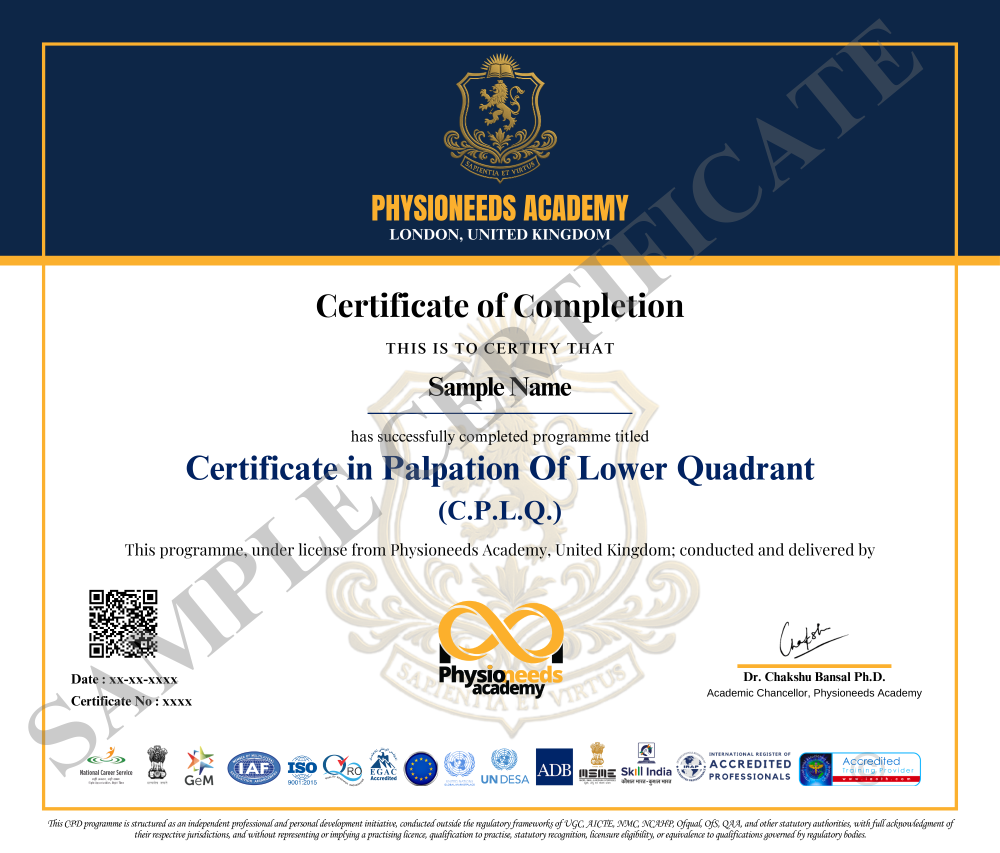
Sample Palpation - Lower Quadrant certificate image - landscape format
FAQs

Questions Before You Enroll?

This advanced course is designed for physiotherapists, sports therapists, manual therapy practitioners, osteopaths, chiropractors, rehabilitation professionals, and eligible healthcare learners seeking structured lower-quadrant palpation skills.
The source course is listed at an advanced skill level. It is best suited to healthcare and rehabilitation professionals who already understand foundational anatomy, movement assessment, patient positioning, and clinical examination principles.
Yes. It covers consent, positioning, safety, lower-quadrant landmarks, muscle-specific palpation, tissue differentiation, layer-by-layer assessment, movement-based confirmation, demonstrations, and clinical correlation.
Yes. Once enrolled, you receive lifetime access to the course material, practical demonstrations, learning resources, and updates so you can revisit lower-quadrant anatomy and palpation techniques whenever needed.
Yes. It is a single one-time payment with no subscriptions or hidden fees. Your enrollment fee is shown above with no subscriptions or hidden fees.
Yes. After completing the Certification Course in Palpation - Lower Quadrant, you can use CPLQ as the course suffix on your resume, professional profile, clinical-practice materials, and social media.
You will learn lower-quadrant anatomy, surface landmarks, patient positioning, palpation of the soleus, quadriceps, hamstrings, piriformis, gluteals, tensor fasciae latae, tibialis posterior, peroneals, layer-by-layer methods, movement-based palpation, biomechanical correlation, and clinical integration.
The certificate is issued through Physioneeds Academy, which states that its programs are trusted by professionals in 190+ countries. Recognition and scope of practice may still depend on local professional regulations.
Need Help?

Still Thinking? Talk to Our Team First.

Call / WhatsApp:
+91-8800220066  |  +91-9990100373

🔥 Limited-Time Offer

Master Lower Quadrant Palpation — Build Advanced Skills for Accurate Assessment and Rehabilitation.

10 core modules. Lower-quadrant anatomy. Surface landmarks. Muscle-specific palpation. Layer-by-layer assessment. Movement-based techniques. Biomechanical correlation. Case studies. Lifetime access. Certificate. All with one-time enrollment fee.
Loading enrollment fee...