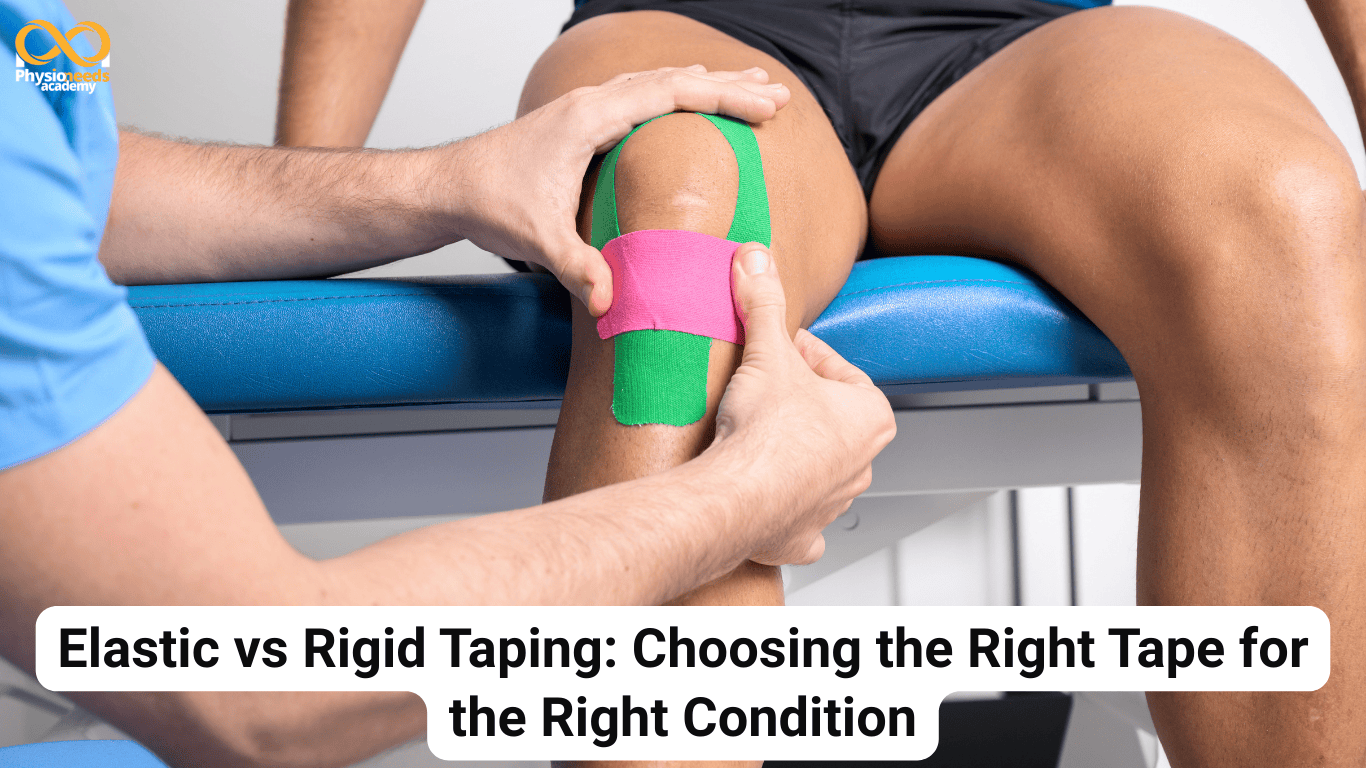
Elastic vs Rigid Taping: Choosing the Right Tape for the Right Condition

One of the most common clinical mistakes in taping is not how tape is applied—but which tape is chosen. Elastic tape is used where rigid tape is needed.
Rigid tape is applied where movement is essential. The result?

  • Reduced effectiveness
  • Patient discomfort
  • Poor clinical outcomes
Expert physiotherapists don’t tape by habit—they tape by clinical logic.

Understanding the Purpose of Taping

Before choosing tape, answer one question:
Do I want to guide movement or restrict it?
That single decision determines whether elastic or rigid taping is appropriate.

Elastic Taping: Supporting Without Restricting

Elastic (kinesiology) tape is designed to:

  • Stretch with the skin
  • Allow full range of motion
  • Provide continuous sensory input
Clinical Goals of Elastic Taping

Elastic taping is used to:

  • Improve proprioception
  • Facilitate or inhibit muscle activity
  • Reduce pain through sensory modulation
  • Assist movement control
  • Support fascia and soft tissues
It is ideal when movement is necessary for recovery.

Common Indications for Elastic Taping

Elastic taping works best in:

  • Musculoskeletal pain syndromes
  • Postural dysfunctions
  • Tendinopathies
  • Muscle imbalance
  • Sports rehabilitation
  • Early and mid-stage rehab
Elastic tape does not immobilize—it educates the nervous system.

Rigid Taping: Controlling Excessive Movement

Rigid tape is non-elastic and provides:

  • Mechanical stability
  • Joint positioning control
  • Movement restriction
Clinical Goals of Rigid Taping

Rigid taping is used to:

  • Protect injured structures
  • Limit harmful movements
  • Provide external stability
  • Prevent re-injury during activity
It is best when movement needs to be controlled or temporarily restricted.

Common Indications for Rigid Taping

Rigid taping is appropriate for:

  • Acute ligament injuries
  • Joint instability
  • Post-injury protection
  • Return-to-play support
  • High-risk sporting activities
Rigid tape sacrifices mobility for safety and control.

Why Choosing the Wrong Tape Fails Treatment

Using elastic tape when stability is needed:

  • Increases injury risk
  • Fails to control joint motion
Using rigid tape when movement is required:
  • Inhibits rehabilitation
  • Causes stiffness and dependency
The tape didn’t fail—the clinical decision did.

Expert Tip: Combine When Necessary

Advanced physiotherapists often use:

  • Rigid tape for joint control
  • Elastic tape for muscle and proprioceptive support
This hybrid approach allows:
  • Protection + movement
  • Stability + neuromuscular control
Combination taping reflects advanced clinical reasoning.

Reassessment Is Non-Negotiable

After taping, always reassess:

  • Pain
  • Range of motion
  • Functional movement
If taping doesn’t change function, it doesn’t belong in the plan.

Final Clinical Takeaway

Elastic and rigid tapes are tools—not solutions. The effectiveness of taping depends on:

  • Correct assessment
  • Clear treatment objective
  • Appropriate tape selection
    The right tape, used for the right reason,
    makes rehabilitation faster and safer.

🔗 Master Clinical Taping Skills

At Physioneeds Academy, physiotherapists learn:

  • Elastic, rigid & fascial line taping
  • Indication-based tape selection
  • Sports & postural taping
  • Integration with MSK rehabilitation
Because taping without reasoning is just decoration.