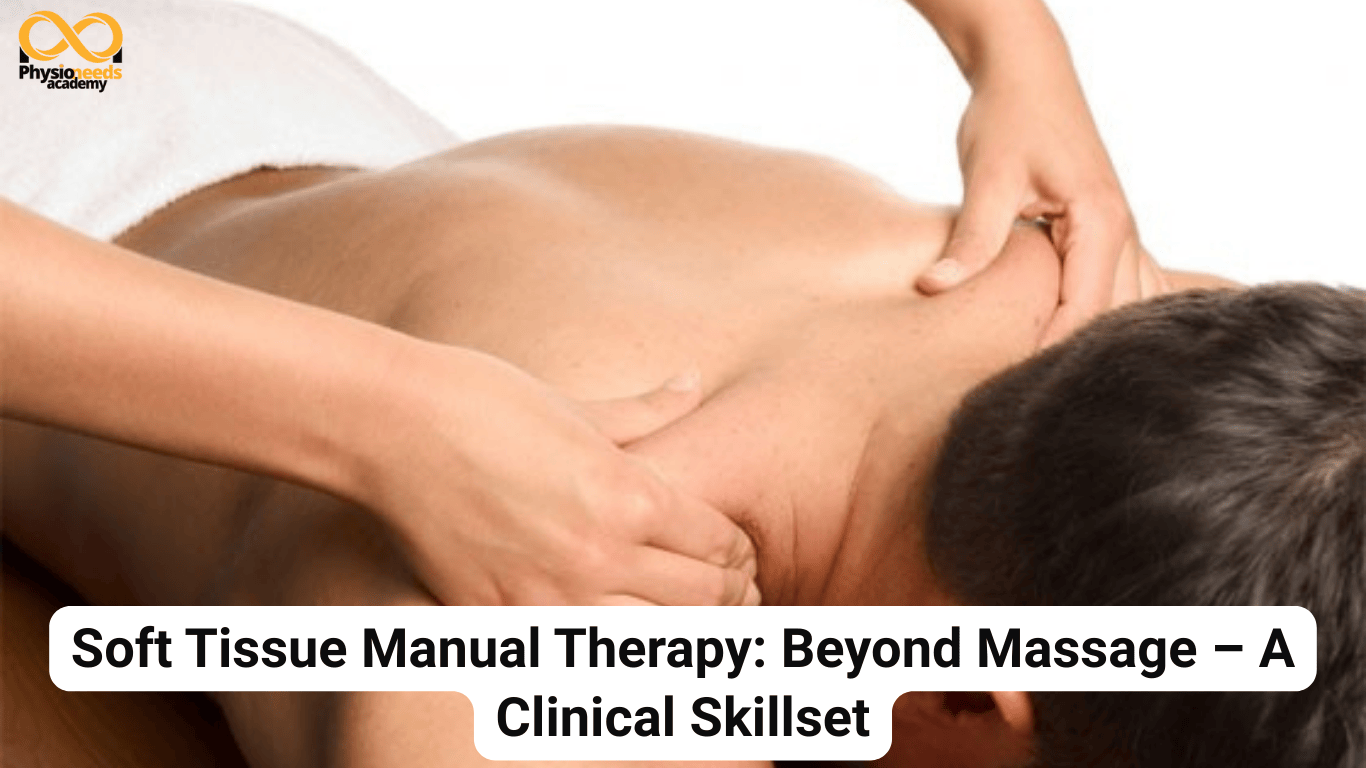
Soft Tissue Manual Therapy: Beyond Massage – A Clinical Skillset

If soft tissue work were “just massage,”
then chronic pain, stiffness, and movement restrictions would be easy to fix.

But every experienced physiotherapist knows the truth.

Patients with long-standing pain don’t need relaxation—they need precision-based soft tissue intervention rooted in anatomy, biomechanics, and clinical reasoning.

That is where soft tissue manual therapy stands far beyond massage.

Massage vs Soft Tissue Manual Therapy: The Critical Difference

Massage focuses on:

  • General relaxation
  • Comfort
  • Temporary symptom relief
Soft tissue manual therapy focuses on:
  • Dysfunctional tissues
  • Movement restriction
  • Pain generators
  • Functional restoration
Massage feels good.
Soft tissue manual therapy changes tissue behavior.

What Is Soft Tissue Manual Therapy—Clinically?

Soft tissue manual therapy is a group of advanced hands-on techniques aimed at treating:

  • Muscles
  • Fascia
  • Tendons
  • Ligaments
  • Scar tissue
It includes: Each technique has a specific indication, not a generic application.

Why Exercises Fail Without Soft Tissue Work

Restricted soft tissue:

  • Alters joint mechanics
  • Inhibits muscle activation
  • Creates faulty movement patterns
  • Maintains chronic pain loops
You cannot strengthen a muscle that cannot lengthen properly.
You cannot correct movement on a dysfunctional foundation.

Soft tissue manual therapy prepares the body to accept exercise.

The Role of Fascia: The Missing Clinical Link

Fascia is not packing material—it is a force transmission system.

When fascia becomes restricted:

  • Pain spreads beyond the original site
  • ROM decreases without joint pathology
  • Posture fails to correct despite exercise
Advanced soft tissue techniques address myofascial chains, not isolated muscles—this is why results become global, not local.

Clinical Precision Matters

Effective soft tissue work depends on:

  • Palpation accuracy
  • Tissue differentiation
  • Directional force
  • Depth control
  • Patient positioning
This is not intuitive—it is a learned clinical skill.

Physiotherapists who master soft tissue manual therapy:

  • Stop guessing
  • Treat with intent
  • Achieve faster outcomes
  • Gain patient trust

Case Insight: When Soft Tissue Makes the Difference

A patient with chronic shoulder pain shows:

  • Normal imaging
  • Full passive ROM
  • Persistent pain with movement
The issue is not the joint—it is rotator cuff and scapular fascial restriction.

Soft tissue release restores:

  • Tissue glide
  • Neuromuscular control
  • Pain-free movement
This is clinical reasoning—not trial and error.

Integration Is the Gold Standard

Soft tissue manual therapy works best when integrated with:

  1. Accurate assessment
  2. Targeted tissue release
  3. Manual joint techniques
  4. Corrective exercise
  5. Movement re-education
This integration defines modern musculoskeletal physiotherapy.

Final Clinical Takeaway

Soft tissue manual therapy is not an “add-on.”
It is a core clinical competency for physiotherapists treating real-world pain.

If your hands are not skilled,
your results will always be limited.

🔗 Skill-Up Beyond Basics

At Physioneeds Academy, physiotherapists learn:

  • Advanced soft tissue techniques
  • Trigger point & fascial release
  • Clinical palpation mastery
  • Integration with manual therapy & rehab
Because hands-on skill is what separates average treatment from exceptional outcomes.